
ACE VR adds an interactive virtual environment to the options available for practice. It provides scenarios, timing and scoring through a compatible Meta Quest headset and ACE handset. This guide explains what the system offers, the equipment and membership it requires, and the limits to keep in mind.
The ACE VR Virtual Shooting Handset for Meta Quest approaches that problem from a different direction. Instead of replacing dry fire with a video game, it places familiar shooting mechanics inside an interactive virtual environment where the shooter can engage multiple targets, move through stages, measure performance, and repeat the same exercise immediately. The available content can change as the app is updated. Check ACE’s current feature list rather than choosing solely by the number of scenarios.
What you need and what the purchase includes
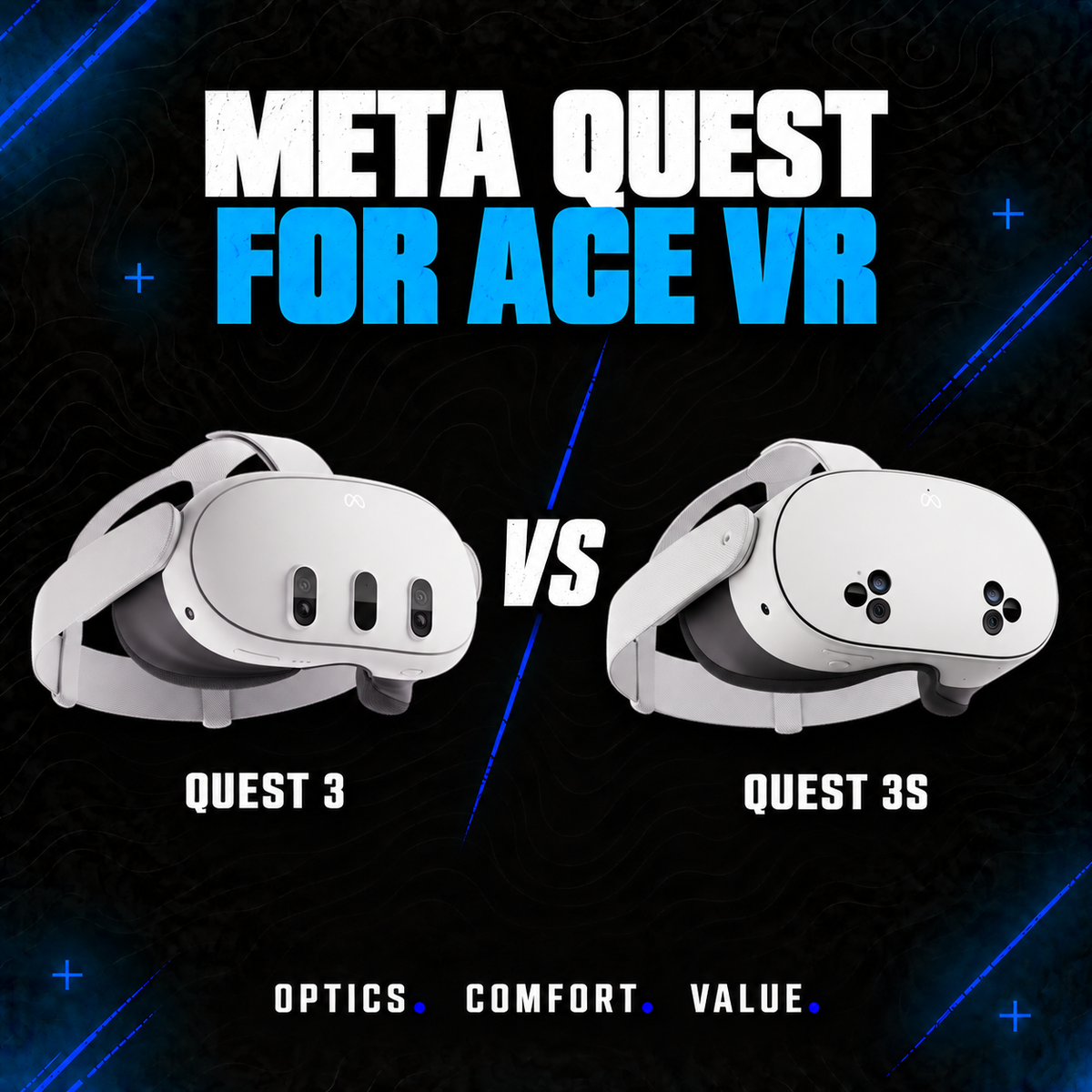
ACE currently supports Meta Quest 2, Quest 3S and Quest 3. You need compatible Quest hardware, an ACE handset and an active paid ACE Club membership. ESTTAC’s standalone handset listing does not include the subscription; it must be purchased separately from ACE. Check the exact bundle contents before ordering.
Include ongoing membership in the total cost, alongside the headset and any optional accessories. Plans and promotions can change; consult ACE’s membership information for current terms.
What Is the ACE VR Shooting Simulator?

ACE VR is a virtual reality shooting training platform designed for Meta Quest headsets. The system combines a tracked physical handgun-style controller with virtual ranges, drills, practical shooting stages, scoring, timing, and performance data. Instead of pointing a standard VR controller at a target, the shooter uses a purpose-built handset that provides a more realistic grip angle, presentation, and holster interaction.
For a complete setup, the two main hardware components are the ACE VR handset and a compatible Meta Quest headset. We currently recommend the Meta Quest 3 512GB for users who want the clearest optics and the most refined overall experience. ACE also supports Quest 3S and Quest 2, making it possible to start with different hardware budgets.
The optional ACE VR Pistol Holster adds an important layer for shooters who want to practice the complete draw sequence rather than beginning every repetition from a ready position. Because a large part of practical shooting performance happens before the first shot is fired, being able to rehearse the draw, presentation, movement, and first target acquisition makes the system significantly more useful than a simple point-and-shoot simulator.
Where Traditional Dry Fire Is Still Excellent
Virtual reality does not make conventional dry fire obsolete. Training with your actual unloaded firearm remains the most direct way to refine the exact mechanical interaction with your own equipment. Your real pistol has the exact grip texture, trigger weight, reset, controls, optic height, magazine release, slide geometry, and holster fit you will use on the range or during duty.
Traditional dry fire is particularly strong for:
- Trigger control: You can see whether the sights move as the real trigger breaks.
- Grip development: You train the exact geometry and pressure required by your own firearm.
- Reload mechanics: Real magazines, mag pouches, controls, and indexing can be practiced exactly as they will be used live.
- Draw consistency: Your actual holster, belt height, retention system, and pistol remain identical to your real setup.
- Short focused sessions: A five-minute drill requires virtually no setup and remains one of the highest-value habits a shooter can build.
Our existing guide on practical dry fire drills covers these fundamentals in more detail. ACE should be viewed as an extension of that training rather than a reason to stop using traditional dry fire.
Where ACE VR Changes the Training Experience

The biggest advantage of ACE is not that the virtual pistol feels identical to a live firearm. It does not. The advantage is that the environment can react to what you do. A timer starts, targets appear at different distances and angles, hits are recorded, penalties matter, movement changes your shooting position, and the result can be compared with the previous run.
Target Transitions and Visual Processing
Traditional home dry fire usually relies on small paper targets attached to a wall. That is useful, but the geometry remains static. In ACE, the shooter can work through arrays of targets with different spacing, distances, partials, and shooting positions. This creates a much stronger requirement to move the eyes first, drive the sights to the next target, confirm an acceptable sight picture, and continue through the array.
For IPSC and other practical shooting disciplines, that visual component is critical. A large portion of stage performance comes from how quickly the shooter identifies the next target and how efficiently the firearm arrives where the eyes are already looking. VR provides far more variation for this type of practice than a single room with fixed dry fire targets.
Stage Planning and Movement
A conventional dry fire session can train movement, but reproducing an entire practical shooting stage inside a home is difficult. ACE allows the user to enter virtual stages, identify shooting positions, plan target order, decide where to reload, and then execute the plan against a timer.
This makes it useful for developing skills that sit between pure gun handling and live fire: entering and leaving positions efficiently, keeping the gun ready during movement, minimizing unnecessary steps, and learning how a small planning mistake can affect the final time. Virtual stages can be repeated immediately, allowing the shooter to change one decision and see whether it actually improves the result.
Immediate Performance Feedback
One of the weaknesses of unstructured dry fire is that it is easy to practice without measuring anything. You may feel faster without actually becoming faster. ACE adds timing and scoring to each repetition, which makes progress easier to track and exposes inconsistency.
That feedback loop is particularly valuable when training transitions, first-shot speed, stage execution, and movement. Instead of simply completing ten repetitions, you can compare the quality of those repetitions and identify whether additional speed produced better performance or merely more errors.
ACE VR vs. Traditional Dry Fire vs. Live Fire
No single method covers every part of shooting performance. The most effective training program uses each tool for what it does best.
| Training Method | Best For | Main Limitation |
|---|---|---|
| Traditional Dry Fire | Real trigger, grip, reloads, draw mechanics, equipment familiarity | Limited feedback and static environment |
| ACE VR | Target transitions, visual processing, stage planning, movement, timing, repetition | No real recoil, blast, ammunition, or exact firearm mechanics |
| Live Fire | Recoil control, confirmation of technique, real ballistics, weapon reliability | Higher cost, range access, ammunition consumption, slower repetition volume |
The important point is that ACE does not need to replace live fire to be valuable. If VR lets you complete hundreds of purposeful repetitions between range sessions, then your limited live ammunition can be used to verify and refine skills rather than spending the first part of every range day simply rebuilding familiarity.
What ACE VR Cannot Replicate
A realistic assessment of any simulator must include its limitations. The ACE handset does not generate the recoil impulse of a live firearm. There is no muzzle blast, concussion, cartridge ignition, actual slide movement, ammunition-induced malfunction, or physical consequence from poor recoil management.
That matters because recoil control is not a theoretical skill. Grip pressure, return-to-zero behavior, split times, and shooting performance at speed must eventually be validated with live ammunition. A shooter who trains exclusively in VR can become very efficient at visual processing and stage execution while still having weaknesses that only become visible when the pistol begins cycling under recoil.
There are also equipment-specific skills that remain better suited to real dry fire. If you need to master the exact trigger break of your duty pistol, the activation of a Safariland retention system, or the seating pressure of a specific magazine, use the real unloaded equipment in a properly controlled training environment.
Why VR Can Make Consistent Practice Easier
The most effective training system is often the one you will actually use. Range sessions require travel, ammunition, range availability, setup, and cleanup. Traditional dry fire removes most of those barriers, but some shooters struggle to maintain motivation when repeating the same static drills alone.
VR adds variety and a clear performance objective. You can run a stage, look at the result, repeat it, compare times, and stop after fifteen focused minutes. That lower barrier to structured practice can be more important than any individual technical feature because shooting skill is built through consistent high-quality repetitions over time.
For families, clubs, agencies, and training organizations, an inert VR handset also makes it possible to run simulator sessions without introducing live ammunition into the training exercise. It does not remove the need for proper supervision or safe training procedures, but it opens up environments where live-fire practice would otherwise be impossible.
Who Benefits Most from ACE VR?
ACE has the clearest value for shooters who already understand that simulation is a supplement rather than a substitute for live fire.
- IPSC and practical shooters: High repetition volume for transitions, movement, stage planning, and visual skills.
- New shooters: A low-pressure environment for learning basic presentation, sighting concepts, and range-style exercises before adding recoil and noise.
- Experienced shooters with limited range access: A way to maintain structured practice between live sessions.
- Law enforcement and professional users: A supplementary tool for individual repetitions and instructor-led skill development without consuming duty ammunition.
- Shooting clubs and training organizations: A portable way to introduce structured shooting exercises in classrooms, offices, events, or other non-range environments.
Building an Effective ACE Training Routine

Simply running random stages for entertainment will not produce the same results as deliberate practice. Treat ACE sessions with the same structure you would use at the range.
- Choose one objective: For example, transitions, first-shot speed, movement into position, or stage planning.
- Establish a baseline: Run the drill several times without forcing speed and record a repeatable result.
- Change one variable: Adjust target order, movement, or visual strategy rather than changing everything simultaneously.
- Prioritize clean repetitions: A faster run filled with penalties is not automatically an improvement.
- Validate with real training: Bring the same concept into traditional dry fire and then confirm it during your next live-fire session.
This creates a useful cycle: develop mechanics in dry fire, build visual and decision-making volume in VR, and validate the entire system with live ammunition.
So, Is Virtual Reality the Future of Dry Fire Training?
Virtual reality is unlikely to replace traditional dry fire or live fire, and it does not need to. Its value is in filling the large gap between them. Traditional dry fire gives you exact interaction with your firearm but limited environmental feedback. Live fire gives you recoil and complete weapon behavior but costs more time and ammunition. ACE VR adds interactive targets, stage complexity, scoring, timing, and virtually unlimited repetitions at home.
For practical shooters, that combination is difficult to ignore. The future of shooting training is not one method replacing another; it is a blended training system where each method is used for the skills it develops best.
If you want to build a complete home setup, start with the ACE VR Virtual Shooting Handset, pair it with the Meta Quest 3, and add the ACE VR Pistol Holster if draw practice is part of your training. ESTTAC supplies ACE VR equipment from Estonia with fast delivery across Europe and support for professional, individual, and organizational customers.