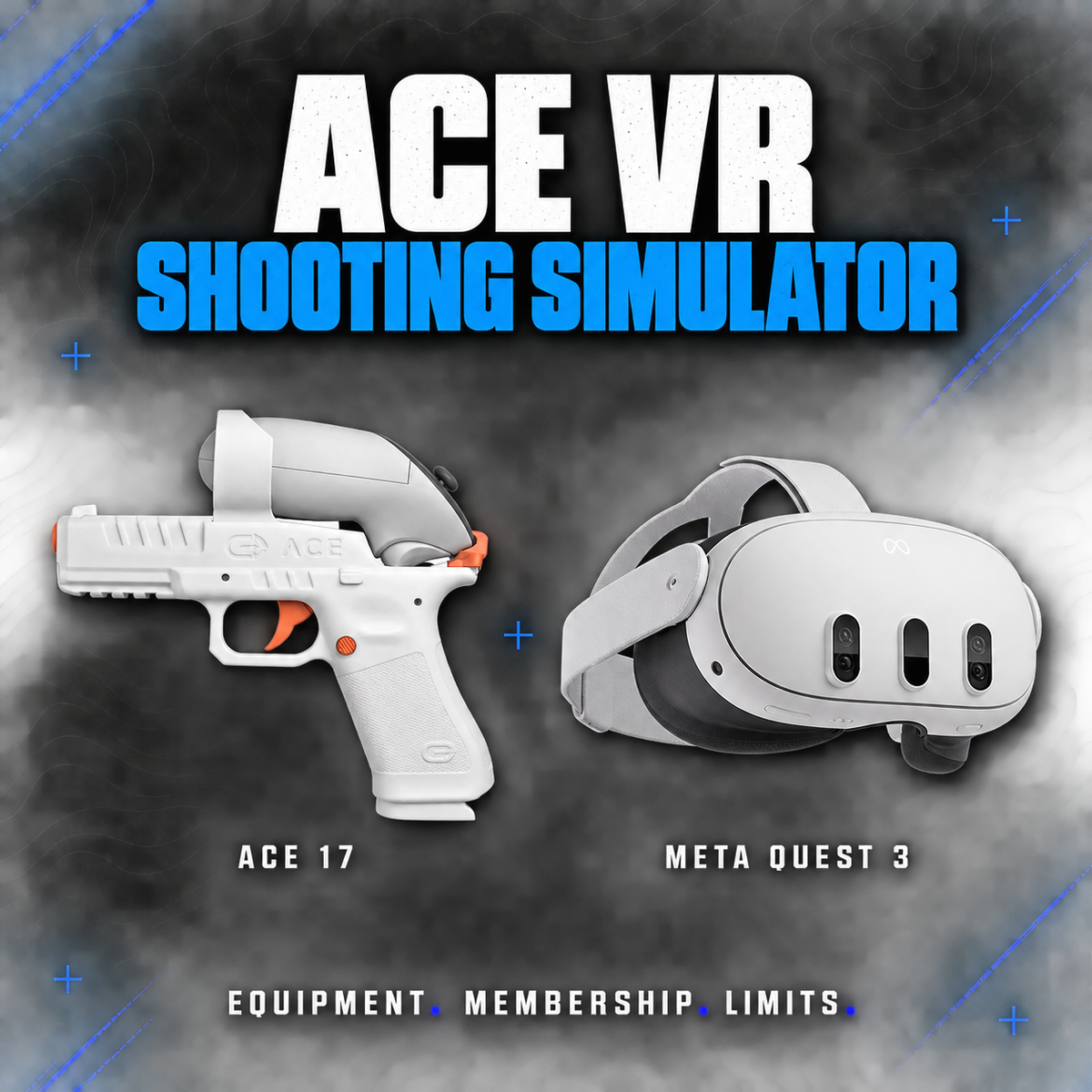

If you are building an ACE VR shooting setup, one of the first questions is simple: which Meta Quest headset should you buy?
ACE currently works with Meta Quest 2, Quest 3S and Quest 3. All three can run the system, but they do not provide the same experience. For most people buying a new setup today, our recommendation is the Meta Quest 3. The reason is not simply that it is the most expensive model. For shooting training, the biggest differences are in the optics, field of view, display clarity and fit — all of which matter when your training depends heavily on what your eyes are doing.
This guide explains the practical differences between Quest 3, Quest 3S and Quest 2, why we recommend Quest 3 for the best ACE experience, and why we also recommend replacing the standard head strap with a more supportive battery strap such as the Vortex Elite Strap with 6000 mAh battery.
What you need and what the purchase includes
ACE currently supports Meta Quest 2, Quest 3S and Quest 3. You need compatible Quest hardware, an ACE handset and an active paid ACE Club membership. ESTTAC’s standalone handset listing does not include the subscription; it must be purchased separately from ACE. Check the exact bundle contents before ordering.
Include ongoing membership in the total cost, alongside the headset and any optional accessories. Plans and promotions can change; consult ACE’s membership information for current terms.
Quick Comparison: Quest 3 vs Quest 3S vs Quest 2
| Feature | Meta Quest 3 | Meta Quest 3S | Meta Quest 2 |
|---|---|---|---|
| ACE compatibility | Yes | Yes | Yes |
| Chipset | Snapdragon XR2 Gen 2 | Snapdragon XR2 Gen 2 | Snapdragon XR2 Gen 1 |
| Memory | 8 GB | 8 GB | 6 GB |
| Resolution per eye | 2064 × 2208 | 1832 × 1920 | 1832 × 1920 |
| Horizontal field of view | 110° | 96° | Approx. 96° |
| Vertical field of view | 96° | 90° | Approx. 90° |
| Lens system | Pancake optics | Fresnel optics | Fresnel optics |
| IPD adjustment | Continuous adjustment | 3 preset positions | 3 preset positions |
| Passthrough | Color stereoscopic with depth sensor | Color stereoscopic | Grayscale |
| Typical battery life | About 2 hours | About 2.5 hours | Roughly 2–3 hours depending on use |
Specifications checked on 26 September 2026 against Meta’s device comparison and ACE’s compatibility information. Field of view varies with fit; battery life depends on use. Quest 2 is an older model.
The most important thing to understand is that Quest 3S is not a slow version of Quest 3. Both use the Snapdragon XR2 Gen 2 processor and 8 GB of memory. The main difference is the optical system.
Why We Recommend Meta Quest 3 for ACE VR

Shooting is an extremely visual activity. In practical shooting, your eyes are constantly moving from one target to the next, reading stage geometry, finding visual references and guiding the gun through transitions.
That is why the headset's optical system matters more for ACE than it might for a simple VR game.
1. Pancake optics give you a clearer image across more of your view
Quest 3 uses pancake lenses, while Quest 3S and Quest 2 use Fresnel lenses. This is one of the biggest real-world differences between the headsets.
With Fresnel lenses, image quality is most critical around a smaller central sweet spot. If the headset moves slightly on your face or your eyes look away from the center, the image can become less clear. Pancake optics give Quest 3 a much more forgiving viewing area, so you can move your eyes around the scene without needing to turn your entire head as much just to keep the image sharp.
For ACE, that is useful because good shooting technique depends on moving your eyes ahead of the gun. When transitioning between targets, you want to identify the next target visually and let the gun follow. A clearer image outside the center of the lens makes this feel more natural.
2. Quest 3 has a noticeably wider field of view
Meta lists Quest 3 at 110° horizontal and 96° vertical field of view, compared with 96° horizontal and 90° vertical on Quest 3S.
That difference is useful in stage-based training. A wider field of view lets you see more of the environment without turning your head as far. It gives you better awareness of target locations, shooting positions and stage geometry.
This does not magically improve shooting skill, but it makes the virtual environment feel less restricted and allows visual processing to happen in a way that is closer to natural movement.
3. Higher resolution means a sharper sight picture and cleaner targets
Quest 3 has a physical resolution of 2064 × 2208 pixels per eye and approximately 25 pixels per degree. Quest 3S uses 1832 × 1920 per eye at around 20 pixels per degree.
In a shooting simulator, this matters because you spend a lot of time looking at relatively small details: target edges, sights, optics, scoring zones and distant targets. The sharper display on Quest 3 makes these elements easier to read and reduces the feeling that you are looking through a lower-resolution screen.
Meta's own developer documentation also shows that Quest 3 uses a higher physical display resolution than both Quest 3S and Quest 2, while Quest 3 and 3S share the same modern XR2 Gen 2 performance class.
4. Continuous IPD adjustment makes setup easier
IPD is the distance between your pupils. If the lenses do not line up properly with your eyes, the image can feel less clear and the headset can become uncomfortable over longer sessions.
Quest 3 allows continuous IPD adjustment with a slider. Quest 3S uses three preset positions. The preset system works for many people, but Quest 3 makes it easier to fine-tune the headset to the individual user.
This is especially useful if several people use the same training system. In a club, training organization or professional environment, being able to adjust the headset quickly and precisely for different users is a practical advantage.
Is Quest 3S Good Enough for ACE?
Yes. Quest 3S is a very good ACE headset and is the option we would recommend when budget is the main consideration.
It uses the same Snapdragon XR2 Gen 2 processor and the same 8 GB of memory as Quest 3. It can therefore run modern Quest software with the same basic generation of performance, and ACE itself specifically supports Quest 3S.
The compromise is mainly visual. Quest 3S uses the older Fresnel-style optical system, has a lower-resolution display, a narrower field of view and only three IPD positions.
If someone wants to enter ACE at the lowest reasonable cost with a new headset, Quest 3S makes sense. If someone asks us which headset we would personally choose for regular shooting training, we would still choose Quest 3 because the better optics affect every minute of every session.
What About Meta Quest 2?
If you already own a Quest 2, there is no reason to wait before trying ACE. ACE officially supports it, and it remains capable of running the platform.
However, we would not normally recommend buying a Quest 2 today specifically to build a new ACE setup.
Quest 2 uses the older Snapdragon XR2 Gen 1 chipset and 6 GB of RAM. Meta lists Quest 3 GPU performance at roughly 2.5 times the Quest 2 baseline. Quest 2 also uses a lower-generation optical system, grayscale passthrough and older controller hardware.
Another practical issue is that Quest 2 has been discontinued. Meta no longer sells it as a current headset. That does not make it useless, but it does mean that a new buyer is investing into an older platform when Quest 3S and Quest 3 are already the current generation.
Our recommendation is simple: if you already have a Quest 2, use it. If you are buying specifically for ACE today, choose Quest 3S or Quest 3 instead.
Why Comfort and Headset Stability Matter More in ACE Than in Many VR Games
The headset itself is only part of the experience.
ACE involves quick head movement, target transitions, body rotation and movement through virtual stages. If the headset moves around on your face during these actions, two things happen: comfort gets worse and the lenses move away from the ideal position relative to your eyes.
This is why we do not consider the standard head strap to be the ideal long-term solution for serious ACE use.
The original soft strap is lightweight and compact, but it places more of the headset's weight toward the front of the face. During a longer training session, that can create pressure on the forehead, cheeks and nose. It can also require more tightening to keep the headset stable during dynamic movement.
Why We Recommend the Vortex Elite Strap with 6000 mAh Battery

We sell the Vortex Elite Strap with 6000 mAh Battery for Meta Quest 3 and Quest 3S because it solves two practical problems at the same time: comfort and battery life.
Better weight distribution
The Vortex strap adds structure and rear support behind the head, helping distribute the headset's weight between the front and rear rather than concentrating most of the pressure on the face.
The benefit is not just comfort. Better balance also helps the headset stay in a more consistent position while moving quickly between targets or moving through a stage.
Faster adjustment between users
The rear adjustment dial makes the headset much easier to tighten and loosen compared with the standard fabric strap.
For a personal setup, that means you can find your preferred fit quickly. For a club, training organization or shared system, it matters even more because the headset can be adjusted between users in seconds.
Longer training sessions
The Vortex strap has a built-in 6000 mAh battery. According to the product specification, it can extend playtime by up to approximately two additional hours depending on the application and headset load.
This is particularly relevant with ACE because the platform tends to encourage long sessions. It is easy to start with the intention of doing 20 or 30 minutes of training and continue much longer once you begin repeating stages and chasing better times.
A battery strap means the headset is less likely to become the reason the session ends.
Do You Need the Battery Strap to Use ACE?
No. ACE works perfectly well with the standard Quest strap, and the Vortex battery strap is not required.
We recommend it because it improves the parts of the system that become noticeable after regular use: headset stability, pressure on the face, adjustment speed and available training time.
This distinction is important. We do not think every accessory is necessary simply because it can be added to a VR headset. We prefer accessories that solve a real problem we have noticed in use.
The Vortex strap is one of those accessories.
Our Recommended ACE VR Setup
If we were putting together an ACE system today for regular use, our preferred setup would be:
- Meta Quest 3
- ACE VR handset
- ACE-compatible holster
- Vortex Elite Strap with 6000 mAh battery
This is our suggested combination for image clarity and adjustable fit. The extra strap is optional, and comfort should be assessed individually.
Which Headset Should You Choose?
Choose Meta Quest 3 if: you want the best overall ACE experience, plan to train regularly, value visual clarity and want the easiest headset to adjust precisely.
Choose Meta Quest 3S if: you want a current-generation headset at a lower price and are willing to accept less advanced optics.
Keep using Quest 2 if: you already own one and want to start training without buying another headset immediately.
For most new ACE buyers, our recommendation remains Quest 3.
The Headset Does Not Make You Better — Better Training Does
It is worth keeping the hardware in perspective. Quest 3 will not make someone a better shooter simply because the display is sharper.
What better hardware does is remove friction. Clearer optics make visual work easier. A wider field of view makes virtual stages feel more natural. Better adjustment reduces eye strain. A supportive battery strap improves stability and lets you train longer.
When the system is comfortable and easy to use, you are more likely to train often. And as we discussed in our previous ACE training article, the largest advantage of virtual shooting is the number of useful repetitions you can accumulate in a limited amount of time.
That is the reason we recommend this setup. Not because every component is mandatory, but because each one improves a part of the experience that matters when you use ACE seriously.
If you are building an ACE VR shooting setup in Europe, ESTTAC can supply the ACE handset, Meta Quest hardware and compatible accessories, and help you choose the right configuration for personal training, clubs, training organizations or professional use.